






Product Overview Options Reviews
Home > SAFES & SECURITY BOXES > Security Safes & Boxes

Security Safes & Boxes

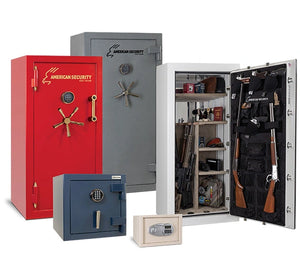
Security Safes include a broad range of safes used to prevent theft and fire damage, or theft alone. A business security safe or a home security safe may vary widely in terms of its size and weight, intended mounting location, level of burglary resistance, and degree to which it will resist damage from fire. A security safe may be secured by several types of locking mechanisms, both mechanical and electronic....[Read More]
Most security safes are designed to be mounted or tethered to a fixed object to prevent them from being removed. Light-weight security safes that cannot be secured to a fixed object should be avoided, except in the case of security safes being used solely for the purpose of resisting fire damage.

There are several different ways that security safes may be secured to a fixed object:
  • To Floor. Many security safes come with one or more pre-drilled anchor holes located at the base of the safe for anchoring the safe to a wood or concrete floor. Anchoring a safe to a concrete floor is more secure than anchoring it to a wood floor. If the chosen installation location is a wood floor, ideally at least one anchor bolt should be secured to a support beam. Class B and higher burglary-only security safes usually have four 1/2" anchor holes located at the four corners of the base of the safe. Composite fire/burglary security safes usually have one recessed anchor hole in the center of the base of the safe.
  • In-Floor. In-floor security safes are a type of security safe designed to be installed in a concrete slab at basement level such that the safe and its companion cover plate are mounted flush with the surrounding concrete. When properly installed in a concrete slab, in-floor safes are very resistant to both burglary and fire. In addition, because in-floor safes are installed flush with the floor, they may be easily concealed by a carpet or some other object. In-floor safes are rarely burglarized and are some of the most secure safes available.
  • To Wall. Security safes that are not fire resistant often come with two pre-drilled anchor holes through the back wall of the safe for anchoring the safe to a wall. In general, anchoring a safe to a wall is not as secure as anchoring a safe to a floor.
  • In-Wall. In-wall security safes are designed to be installed between standard wall studs spaced 16" apart on center. Installation involves cutting a hole in the drywall between the studs, placing the safe between the wall studs, and then anchoring the safe to the wall studs. When installed, in-wall security safes are flush with the surrounding dry wall and can easily be concealed by a picture or a mirror.
  • Security Cable. Some security safes are designed to be tethered to a secure object via a steel security cable. While simple to install, this mounting option provides little security as the security cable may be easily removed with a bolt cutter or similar tool.

Security safes are available in varying levels of burglary resistance:

  • Basic Security. Security safes that provide only a basic level burglary resistance are typically lightweight safes constructed of minimal amounts of steel. These types of safes are relatively inexpensive and may be useful for keeping valuables away from cleaning personnel, household guests, roommates, etc. However, these safes are not very burglary resistant and may not provide an adequate level of burglary resistance in the event of a break-in.
  • Class B. Class B safes are stronger than security safes that provide only Basic Security. These safes have doors that are constructed of a minimum of 1/2" steel. The body of these safes is constructed of a minimum of 1/4" steel. These safes often come with larger anchor holes (1/2") for more secure anchoring to a floor. Safes of this type also often have additional security features built into the safe that lower-rated safes do not, such as relocking devices, drill-resistant hard plates, larger and more locking bolts, and higher quality bolt work. Class B safes also have more secure and reliable locking mechanisms, such commercial grade dial combination locks and keypads. While costing more, safes of this type offer a higher degree of security and are available with more reliable, longer-lasting locking mechanisms.
  • Class C. Class C safes are similar to Class B safes, except that they are constructed of even thicker steel. Class C safes have doors that are constructed of a minimum of 1" of steel. The body of these safes is constructed of a minimum of 1/2" steel.
  • TL-15/TL-30+. Rarely used in residential applications, tool-rated safes, such as TL-15 and TL-30 rated safes, are designed to resist sophisticated burglary attempts for short periods of time.

Security safes are available in varying levels of fire resistance including 30 minutes, 60 minutes, and 120 minutes.

Security safes are available with a variety of locking options:

  • Dial combination Lock with a Companion Key Lock. A safe with this type of lock has a dial combination lock with a separate key lock. To open the safe, you need to dial the combination correctly and then use the companion key to open the safe. If the safe has a Group II dial combination lock, the combination can be changed by a technician. If the safe has a proprietary dial, in general the combination cannot be changed.
  • Electronic lock with a Companion Key Lock. A safe with this type of lock has an electronic lock with a digital keypad and a separate key lock. To open the safe, you need to enter your combination on the keypad and then use the companion key lock to open the safe. The combination can be changed by following the instructions included with the safe.
  • Dial Combination Lock Alone. To open a safe with this type of lock, you simply dial the combination. If the safe has a Group II dial combination lock, the combination can be changed by a technician. If the safe has a proprietary dial, in general the combination cannot be changed.
  • Electronic Lock with Mechanical Key Override. To open a safe with this type of lock you normally simply enter your combination on the keypad. If the lock malfunctions, you can use the mechanical override key included with the safe to open the safe manually. You can change the combination by following the instructions included with your safe.
  • Electronic Lock Alone. To open a safe with this type of lock, you simply enter your combination of the keypad. You can change the combination by following the instructions included with your safe.
  • Mechanical Pushbutton. A safe with this type of lock opens by entering your code on the buttons on the lock. This type of lock is mechanical and does not require power or batteries to operate. However, you can change the combination at will by following the instructions included with your safe.
  • Biometric. To open a safe with this type of lock, you simply swipe your finger on the fingerprint reader. The fingerprint reader compares its scan of your fingerprint with its record of authorized fingerprint scans. If there is a match, the safe will open. If not, the user will be denied entry. Users can be added or deleted from the access list easily. Modern biometric fingerprint locks are highly reliable.